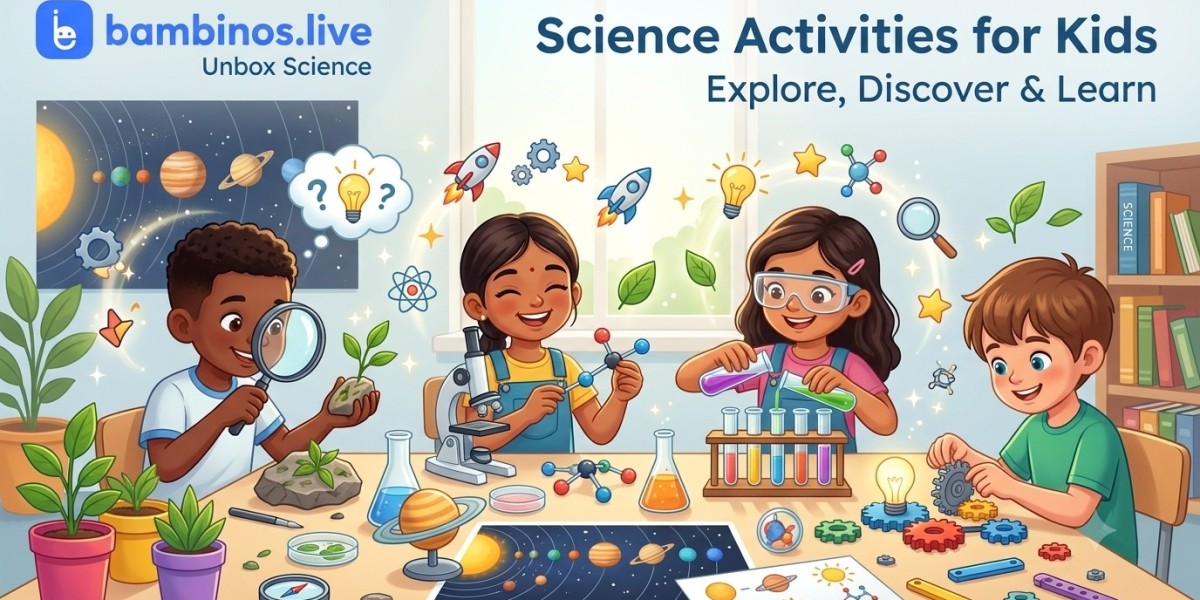

Science activities help children explore the world around them, ask questions, and understand how things work.
Through experiments, observations, and hands-on activities, children can develop curiosity and problem-solving skills.
Bambinos.live Unbox Science supports children with engaging learning experiences that encourage exploration and discovery.
Many parents look for ways to make science learning more interesting for their children. Instead of only memorising facts, children can learn better when they get opportunities to observe, experiment, and discover answers through activities.
Science is present in everyday experiences, from understanding plants and weather to exploring simple reactions and movements. Encouraging curiosity at an early age can help children develop a habit of asking questions and finding solutions.
Bambinos.live Unbox Science provides expert-led learning support through interactive activities that encourage children to explore scientific concepts in an engaging way.
Why Are Science Activities Important for Children?
Science activities give children opportunities to learn through observation and exploration. When children participate in experiments and practical activities, they can connect concepts with real-life experiences.
Science activities can help children:
- Develop curiosity about the world around them
- Practice observation and questioning skills
- Understand concepts through practical examples
- Explore creative ways to solve problems
- Build interest in scientific thinking
A supportive learning environment allows children to explore ideas, make observations, and learn from their experiences.
How Science Activities Develop Important Learning Skills
Encouraging Children to Ask Questions
Curiosity begins with questions. Children naturally want to understand why things happen and how objects work.
Parents can encourage curiosity by asking questions such as:
- Why do you think this happened?
- What do you notice?
- What do you think will happen next?
These conversations encourage children to think, observe, and share their ideas.
Building Problem-Solving Skills Through Experiments
Science experiments allow children to explore possible solutions and understand cause-and-effect relationships.
For example, a simple activity like observing which objects float or sink can encourage children to make predictions, test ideas, and discuss their observations.
Through these experiences, children learn that exploring different possibilities is an important part of learning.
Making Learning More Engaging Through Hands-On Activities
Hands-on learning allows children to actively participate instead of only listening or reading. Activities like creating models, observing nature, or conducting simple experiments can make science concepts easier to understand.
When children interact with learning materials, they can develop better connections between concepts and everyday experiences with science classes for kids
Simple Science Activities Parents Can Try at Home
1. Nature Observation Activity
Encourage your child to observe plants, insects, or changes in weather. Ask them to note what they see and discuss their observations.
This activity helps children develop attention to detail and encourages curiosity about nature.
2. Sink or Float Experiment
Take safe household objects and ask your child to predict whether each object will sink or float. After testing, discuss why different objects behave differently.
This activity introduces children to scientific thinking through simple observation.
3. Shadow Exploration Activity
Help your child observe how shadows change during different times of the day. Encourage them to share their ideas about why the changes happen.
This creates an opportunity to explore light and movement concepts.
4. Building and Creating Projects
Encourage children to create simple structures using available materials like paper, blocks, or recyclable items.
Building activities can support creativity, planning, and problem-solving skills.
How Bambinos.live Unbox Science Supports Children's Learning Journey
Bambinos.live Unbox Science provides interactive science learning experiences designed to encourage curiosity and exploration. Through experiments, activities, and guided discussions, children get opportunities to explore scientific concepts in an engaging way.
The program focuses on helping children understand science through practical experiences while encouraging them to ask questions, think creatively, and explore new ideas.
Science activities help children explore concepts, ask meaningful questions, and develop problem-solving skills through practical experiences. Parents can support science learning by encouraging curiosity, discussing observations, and trying simple activities together.
With structured guidance and engaging activities, Bambinos.live Unbox Science supports children in exploring science with curiosity and creativity.
Help your child explore the world of science with expert-led learning at Bambinos.live. Book a free demo today to get started.
FAQs
What are science activities for kids?
Science activities for kids are hands-on learning experiences that help children explore scientific concepts through observation, experiments, and discovery. These activities encourage children to ask questions, understand how things work, and connect science concepts with real-life situations in an engaging way.
How do science activities help children's learning?
Science activities encourage children to observe, experiment, and find answers through exploration. They help children develop curiosity, critical thinking, and problem-solving skills while making scientific concepts easier to understand through practical experiences and interactive learning opportunities.
What are some simple science activities children can do at home?
Children can try activities like observing plants, testing objects that float or sink, exploring shadows, and creating simple models. These activities allow children to explore scientific ideas while developing observation skills and understanding concepts through everyday experiences.
Why is curiosity important in science learning?
Curiosity encourages children to ask questions, explore ideas, and understand the world around them. In science learning, curiosity helps children investigate concepts, make observations, and develop a habit of exploring possible explanations through guided activities and experiences.