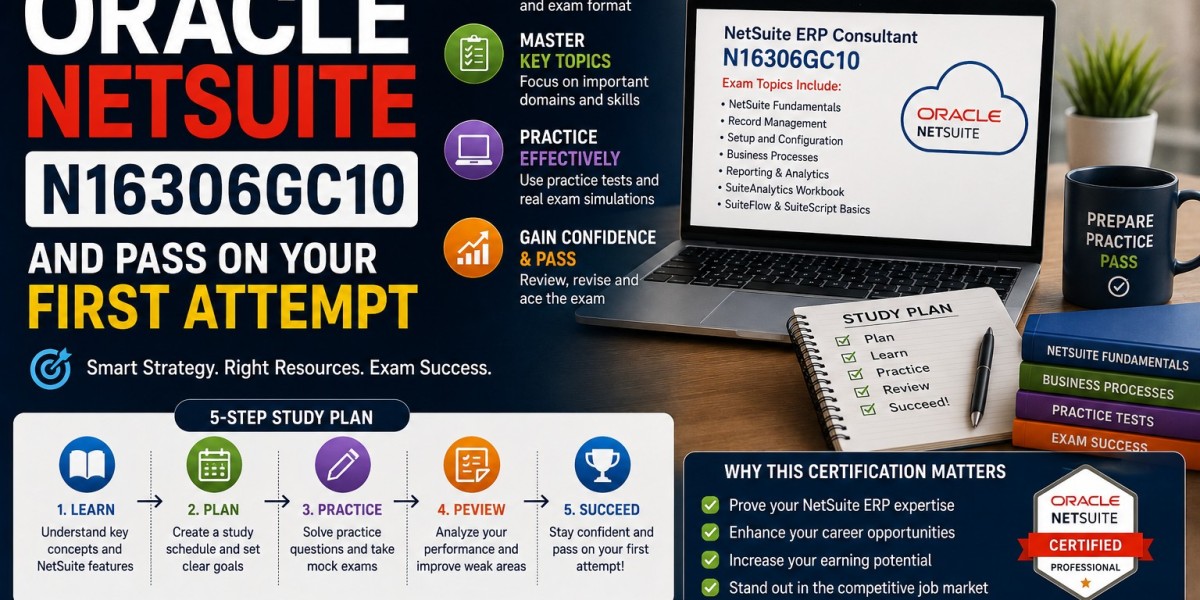

The Oracle NetSuite N16306GC10 exam is associated with the NetSuite Certified Accounts Payable Specialist credential. It is designed for professionals who want to validate practical knowledge of accounts payable processes inside NetSuite, including vendors, purchasing transactions, bills, payments, returns, banking activities, and reporting.
Oracle NetSuite currently includes Accounts Payable Specialist among its newer Specialist-level certification credentials. Oracle’s own certification material confirms that the Accounts Payable Specialist credential is part of its current NetSuite certification program.
Passing N16306GC10 on the first attempt requires more than memorizing accounting terminology. The strongest preparation strategy is to understand the complete procure-to-pay workflow, practice transactions inside NetSuite, review current product documentation, and use practice questions to identify weak areas.
N16306GC10 Exam at a Glance
Exam Detail | Information |
Exam Code | N16306GC10 |
Credential | NetSuite Certified Accounts Payable Specialist |
Vendor | Oracle NetSuite |
Level | Specialist |
Primary Area | Accounts Payable |
Best For | AP users, accountants, NetSuite consultants and finance professionals |
Main Focus | Vendors, purchasing, bills, payments, returns and reporting |
Preparation Style | Workflow study + hands-on NetSuite practice |
Public 2026 exam listings identify N16306GC10 as the Accounts Payable Specialist exam. Because Oracle can revise exam delivery details and product-version alignment, candidates should confirm the current information in Oracle MyLearn before scheduling.
Understand What the Exam Is Really Testing
N16306GC10 is not primarily an accounting-theory exam.
You need to understand how accounts payable work is performed in NetSuite.
That means knowing how one record affects the next.
For example:
Vendor → Purchase Requisition → Purchase Order → Item Receipt → Vendor Bill → Vendor Payment → Reporting
If you study each record independently, scenario questions can become difficult. If you understand the entire transaction lifecycle, the correct response becomes easier to identify.
1. Master Vendor Records First
Start with vendor management because vendors sit at the beginning of most accounts payable processes.
You should understand areas such as:
Vendor creation
Vendor information
Payment terms
Currency
Subsidiary relationships
Accounts payable settings
Vendor categories
Tax-related information
Payment preferences
Do not only learn where fields appear.
Ask how each configuration affects later transactions.
For example, payment terms can influence vendor-bill due dates, while subsidiary relationships can determine where a vendor can be used.
2. Learn the Procure-to-Pay Workflow
This should be one of your highest priorities.
Practice the full purchasing process:
Identify a purchasing requirement.
Create or review a purchase requisition.
Generate a purchase order.
Receive goods or services.
Enter the vendor bill.
Review the accounting impact.
Process payment.
Review transaction history and reports.
Understanding this sequence helps you solve scenario-based questions that ask what should happen before, after, or instead of another transaction.
3. Understand Purchase Orders and Vendor Bills
Candidates should clearly understand the relationship between purchasing documents and accounts payable transactions.
Know the purpose of:
Purchase orders
Item receipts
Vendor bills
Standalone bills
Bill approvals
Purchase-order matching
Accounting impact
A vendor bill records an amount owed to a supplier, but the correct workflow can depend on whether purchasing and receiving processes are being used.
Practice tracing transactions from their source record to the resulting bill.
4. Study Vendor Payments Carefully
Vendor payment processing is another major practical area.
Review:
Selecting bills for payment
Full payments
Partial payments
Payment dates
Bank accounts
Payment methods
Credits
Payment application
Transaction status
You should understand what happens to outstanding balances when payments or credits are applied.
Rather than memorizing menu paths alone, practice creating a bill, paying it, and then checking how the vendor balance changes.
5. Learn Vendor Credits and Returns
Returns can cause confusion because several records may be involved.
Oracle’s current NetSuite record documentation includes records for vendor bills, vendor credits, vendor payments, and vendor return authorizations, showing how these remain part of the active NetSuite transaction model.
Understand:
Vendor return authorization
Returning purchased items
Vendor credits
Applying credits
Impact on balances
Relationship to original transactions
A scenario may ask which transaction should be created when goods are returned or when a supplier issues a credit.
Understanding the business event is more reliable than memorizing a single answer.
6. Practice Search and Reporting
Accounts payable professionals need to find information quickly.
NetSuite provides global search capabilities for locating records and transactions. Oracle documentation notes that Global Search can locate records by keywords, IDs, and record-type prefixes.
Practice finding:
Vendors
Purchase orders
Vendor bills
Payments
Credits
Transactions
Also review the reports and saved searches commonly used to investigate AP activity.
You should be able to answer practical questions such as:
Which bills remain unpaid?
Which payments were made to a vendor?
Which transactions belong to a particular supplier?
What amount is currently outstanding?
Which invoices are approaching their due date?
7. Use a NetSuite Environment Whenever Possible
Hands-on practice is one of the best ways to prepare.
If you have access to a NetSuite sandbox, training account, or work environment, create sample transactions yourself.
A useful practice exercise is:
Create a sample vendor.
Enter purchasing information.
Create a purchase order.
Receive the order.
Create the related vendor bill.
Process a vendor payment.
Create a vendor credit.
Locate the transactions through search.
Review related reports.
This teaches you how records connect rather than treating the syllabus as disconnected facts.
Oracle’s current NetSuite documentation also provides product help, training resources, user guides, release notes, and developer documentation that candidates can use during study.
8. Use Practice Questions After Learning the Workflow
Practice questions are most effective after you have developed the fundamentals.
Use them to determine whether you can recognize the correct NetSuite action from a business scenario.
After every question, ask:
Which AP process is being tested?
Which transaction should occur at this stage?
Why is the selected answer correct?
Why are the alternatives less appropriate?
Could I perform this task inside NetSuite?
Do not focus only on the percentage score.
The purpose of question practice is to reveal weak areas before the real exam.
9. Create an Error Log
Keep a simple table while practicing.
Topic | Mistake | Action |
Vendor bills | Confused standalone bill with PO-based bill | Review bill workflows |
Payments | Incorrect credit application | Create payment lab |
Returns | Wrong transaction selected | Review vendor returns |
Reporting | Could not find outstanding bills | Practice AP reports |
Review the log every few days.
Repeated mistakes usually indicate a concept that needs deeper study rather than more question repetition.
Four-Week N16306GC10 Study Plan
Week 1: NetSuite AP Fundamentals
Focus on:
NetSuite navigation
Vendor records
AP concepts
Terms
Purchasing workflow
Follow transactions manually inside NetSuite whenever possible.
Week 2: Procure-to-Pay
Practice:
Requisitions
Purchase orders
Receiving
Vendor bills
Approvals
Accounting impact
Aim to explain the complete workflow without notes.
Week 3: Payments, Credits, and Reporting
Study:
Bill payments
Partial payments
Vendor credits
Returns
Banking
Searches
AP reporting
Use scenario-based exercises rather than only reading documentation.
Week 4: Practice and Final Review
Complete:
Mixed practice questions
Timed practice
Weak-topic revision
Transaction labs
Error-log review
Looking for N16306GC10 exam preparation resources? Explore updated materials here: https://certempire.com/exam/n16306gc10-exam-questions/
Common N16306GC10 Preparation Mistakes
Avoid preparing only through definitions.
Other common mistakes include:
Ignoring transaction relationships
Skipping hands-on NetSuite practice
Studying old product screenshots without checking current functionality
Ignoring vendor credits and returns
Focusing only on purchasing while neglecting payments
Repeating identical questions until answers become memorized
Not reviewing why an answer was incorrect
Scheduling before you can explain the complete AP workflow
Oracle continues to update NetSuite throughout 2026, including ongoing NetSuite 2026.2 enhancements, so current product documentation should remain part of your preparation.
How to Know You Are Ready
You are approaching exam readiness when you can:
Explain procure-to-pay without notes
Identify the correct transaction for common AP scenarios
Navigate vendor and purchasing records comfortably
Distinguish bills, payments, credits, and returns
Find transactions efficiently
Interpret basic AP reporting
Score consistently across varied practice questions
Explain why your answers are correct
A high practice score matters less if it comes from recognizing repeated questions.
Real readiness means understanding the process.
Conclusion
Passing Oracle NetSuite N16306GC10 on your first attempt is realistic when preparation is centered on actual accounts payable workflows.
Start with vendors and the procure-to-pay process, then build deeper knowledge of purchase orders, receiving, vendor bills, payments, credits, returns, banking, search, and reporting. Use a NetSuite environment whenever possible so that each concept is connected to an actual transaction.
After developing that foundation, use practice questions to identify weaknesses, maintain an error log, and retest the areas where you struggle.
The key is to prepare like an Accounts Payable Specialist rather than simply someone trying to remember exam answers.
FAQs
What certification does N16306GC10 lead to?
N16306GC10 is associated with the NetSuite Certified Accounts Payable Specialist credential. Oracle currently includes Accounts Payable Specialist in its NetSuite Specialist certification portfolio.
Is N16306GC10 difficult?
It can be challenging if you lack practical NetSuite AP experience. Understanding how vendor, purchasing, billing, payment, credit, and reporting records interact makes preparation much easier.
What should I study most for N16306GC10?
Prioritize vendors, procure-to-pay, purchase orders, receiving, vendor bills, payments, vendor credits, returns, banking, search, and AP reporting.
Is hands-on NetSuite experience important?
Yes. Creating and tracing actual transactions helps you understand the relationships between records and prepares you for scenario-based questions more effectively than reading alone.
How should I use N16306GC10 practice tests?
Use them after learning the main workflows. Review every incorrect or guessed answer, identify the related AP process, return to documentation or hands-on practice, and then retest.